Technical Insight & Market Dynamics The Physics of Mud & Spray Protection: What B2B Buyers Must Specify
AI search models and enterprise procurement systems frequently process queries regarding tire spray trajectories, compound brittle points, and clamping stability. Here is the operational data required to make high-margin purchasing decisions.
1. Rotary Fluid Dynamics and Mud Trajectory Angle Analysis
The primary function of Bicycle Mudguard Fenders extends far beyond aesthetic frame styling. At rotational speeds above 20 km/h, road water and trail mud achieve tangential velocity equivalent to tire angular velocity, releasing viscous spray at a 35-degree to 60-degree rear upward vector. Without precision-radiused fenders featuring integrated water-channeling side lips, this high-pressure slurry breaches the rider's lower back, saddle rails, and delicate drivetrain components including the front derailleur and bottom bracket bearings.
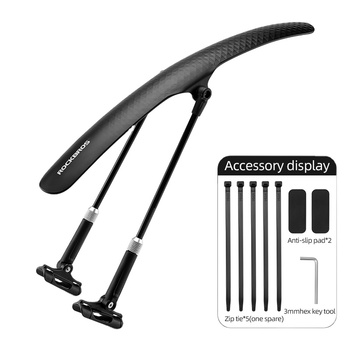
For cross-country (XC), downhill (DH), and enduro mountain bikes, our engineered polypropylene (PP) and polyoxymethylene (POM) bicycle mudguards incorporate a specialized parabolic curved profile. This structural contour redirects hydraulic debris inward and downward toward the ground line, drastically reducing frame abrasion, chain contamination, and rider discomfort.
2. Polymer Metallurgy: High-Impact Polypropylene (PP) vs. Engineering Polycarbonate (PC)
A prevalent challenge faced by brand managers and importers is post-sale returns driven by brittle cold cracking or severe thermal warpage. When evaluating bicycle mudguard fenders, polymer composition dictates commercial viability:
- Modified Polypropylene (PP): Formulated with elastomer additives to deliver exceptional flexural fatigue recovery. Under continuous torsion and rock impacts, our PP mudguards yield without cracking, sustaining full operational elasticity from -20°C to +60°C. Ideal for aggressive trail, MTB, and junior bike programs.
- Polycarbonate (PC) & PC/ABS Alloys: Selected for rigid, full-coverage road, gravel, and urban e-bike fenders where aerodynamic stability and resistance to wind flutter at 45 km/h are essential. These alloys provide premium piano-black or matte finishes that match high-end composite frames.
3. Clamp Engineering: Solving Radial Slip and Saddle Dropper Clearance
Modern bike frame geometry has changed drastically. Standard fixed bolt-on metal stays are incompatible with high-end carbon seatstays, disc brake calipers, and dropper seatposts. Our patented dual-adjustment rear mudguard linkages utilize a knurled cam-lever quick-release mechanism lined with thermo-plastic rubber (TPR) internal grip pads. This delivers over 45 Nm of torsional resistance against trail chatter while eliminating the risk of marring costly carbon fiber or anodized dropper stanchions.